
Scrambling for the Future: Whose Future Are We Actually Talking About?
Report and reflection on the constellation day "Future Generations as a System Player," 2 September 2026, Landgoed Welna
Facilitation and report: Veronique Swinkels
Building on a growing movement
By the fire, in the woods, with six people, three dogs, two crows, and a flock of sheep around us, the central question of the day rang out: how can we let the voice and interests of Future Generations resonate more strongly in the decisions being made right now? During a constellation day, we work through a series of constellations, exercises in which participants physically represent different elements of a system in space and let their positions and movements unfold, to explore an answer to a central question. It became a day in which that question was not answered with a plan or a piece of advice, but with a system that quite literally arranged itself in space, and with an encounter that went deeper than anyone expected.
The questions we brought with us
During the check-in, using cards for life such as Abundance, Rewilding, and Seasons and Cycles, the questions everyone had already been carrying surfaced: what is the next step for the Lab for Future Generations and the other organisations working on future generations? How can all the organisations concerned with Future Generations organise themselves better? How do we get urgency onto the public agenda, and are we actually making impact now? If we had to do just one thing, what, concretely, would that be? How can I meet Future Generations, what do they actually need? How do we make sure they retain choices? We are connected to the larger whole, how do we bring that awareness more fully to life?
Who was absent, and the dynamics around that absence, were also brought into the field: lack of time, governmental crisis, a need for rest, caregiving duties, responsibility for the next generation, grandparenthood, work. That absence, too, belonged to the picture, an early, subtle sign that this subject exhausts people before they even reach the table.
The system currently representing Future Generations
In the first 3D constellation, the current system was made visible, with actors including the future, education, government, business, pioneers, young people, nature, ancestors, fear, technology, religion, imagination, and the tyranny of the urgent.
What was beautiful about this image: the past and the future turned out to be well connected, it felt like a circle, and there was a great deal of energy in the system. The people actively committing themselves stood in the middle, between nature and rest. Ancestors and Future Generations watched over the whole. They did not stand as two separated eras facing each other, past here, future there, but as a single continuum that together surveyed the whole. That is a first, quiet form of connectedness in this image: not time as what separates us, but time as what, across generations, brings us together.
The hard reality was less kind. Young people stood small and disconnected. Loose elements dominated. Interests, power, money, stood alongside pioneers and NGOs, close to the present. Education worked as a barrier rather than a bridge, and had no connection to the future. Government stood far away. The past and imagination had drifted far apart, and young people did not even see that imaginative power; through education, they encountered business first. Business, technology, religion, and fear stood between government and the rest of the system, forming a blockage. Imagination stood alone. And perhaps the sharpest observation of all: there is a constant scrambling for the future, everyone wants a piece of it, and there is no attention for Future Generations themselves. That scrambling is not really about the future as such, it is about a future that each party fills in and defines from its own interest. Rarely is it about a shared, collective future, thought through internationally, socially, and inclusively of nature.
The highest potential of the system lay in what was already there: many people committing themselves, but lacking direction, there is a great deal of distraction. The strength of pioneers and young people is turned inward. Older system players could move more into the background, they are currently in the way. And Future Generations and ancestors could be seen more as pillars of support, rather than as onlookers at a distance.
Meeting Future Generations
The most moving moment of the day was the encounter itself. There she was: curled up small, hands over her ears. She felt boxed in, not free. Without choice. The group asked what she needed in order to stand up.
With the help of someone carrying her, she rose, unsteady, and heavy to carry as well. The primordial mothers stood behind her and took her cold hand. Shiva the dog lay down behind her. The present stayed put and watched. The sun, the energy, offered itself, but from a distance.
There was energy and warmth to draw on, but everyone hesitated. It was not enough. The love had not yet arrived. Not enough love and embrace, not yet.
This image says perhaps more than any analysis could: the system has the will to help, but the warmth has not yet reached Future Generations. There is a hesitation between intention and arrival.
The constellation around the central question: giving the movement direction
After lunch came another constellation, with a sharper question: if we could decide entirely for ourselves, what is the most important movement we need to make? The actors: the earth, government, business, cooperation, the crisis, and the dogs.
The earth took her place in the middle of the circle and stayed there, mobile, yet present, never once changing position. Government threw itself face-down on the ground. Business sat at the edge, its back turned to both earth and government. Cooperation walked around enthusiastically, then sat down and looked at government lying on the ground. The earth said: they don't get it.
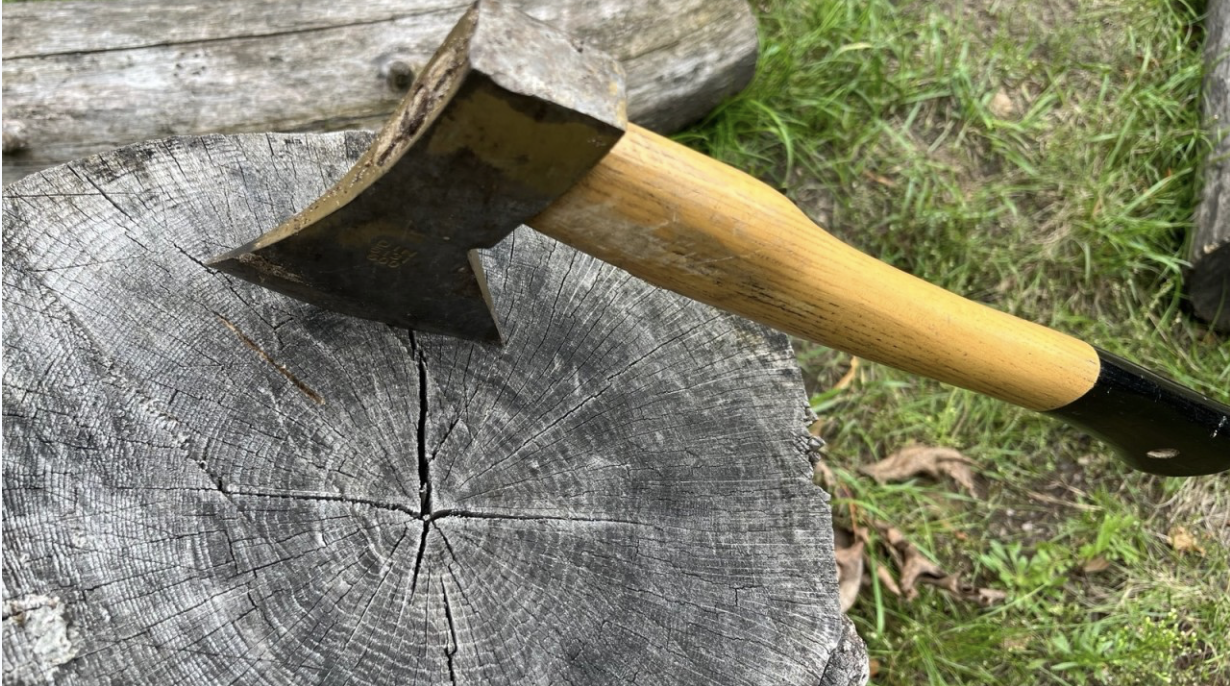
When we brought "the desired movement" into the system, it turned out that "the crisis" made her entrance. And everything changed. She walked out of the circle, came back with an axe, and walked toward business. Business fled. Government stayed down at first, then stood up. The crisis, still holding the axe, also walked toward cooperation, then stood still. Cooperation watched, then went and stood beside the earth. The earth was glad: we need this crisis. That is not a strategic acceptance of something inevitable, it is the refusal to separate what feels good from what feels threatening. The earth does not place the crisis in opposition to herself, as something to be overcome, but within the same field, as something that belongs. That may be the most direct instance of moving beyond duality in the entire day: not the reconciling of two camps, but the experience of shared belonging.
Business explained that this was not its crisis, that the solution did not lie with it, that others should not wait for it, but nonetheless, challenged to look the crisis in the eye, walked toward it and embraced the earth along the way. Business was angry that cooperation was not fulfilling its purpose, and called on the others to give more love. Government, no longer able to stay still, not knowing what to do, unable to look the crisis in the eye, cried out: I can't solve this. Cooperation, standing by the earth, said it most sharply: this is the only cooperation that is actually about something.
What this says about cooperation
If there is one thread running through the different constellations, it is this: cooperation only truly exists once it orients itself toward the earth and the shared future, rather than toward itself or toward preserving the system. In the constellations, we saw loose elements, scrambling, and self-interest around the future, and players who did not participate, government and business were present but absent, not active. Cooperation was there, but non-committal, without clear direction. Only once the crisis was allowed in did cooperation choose a side: it went and stood by the earth.
Timing matters here too. Business's embrace of the earth did not happen after the problem was solved, nor as a reward, but as the movement itself, while the crisis still stood unresolved in the room. An embrace, by definition, closes the distance between "I" and "the other." That moment shows what connectedness can also be: not a conclusion you arrive at once everything is resolved, but a stance taken while looking at something difficult.
The dogs were not incidental here either: they showed interest in both business and cooperation, and ran and barked exactly when the crisis provoked confrontations, as if the system itself, through the animals, sensed where the energy was still stuck and where something was, in fact, beginning to move. The lesson about cooperation, then, is not "cooperate more." It is this: cooperation without a shared compass, no earth, no shared future, no acknowledged crisis, remains scattered and directionless. Cooperation that attaches itself to something larger than the separate interests naturally becomes "the only one that is actually about something."
Freeze, flight, and fight as the language of the system
Looking back at the constellations, something becomes visible that goes beyond a chance image: the system around Future Generations turned out to literally house the three classic survival responses to a threat. Government threw itself face-down on the ground, freeze, the body that stops because the threat feels too big to process. Business walked away, said the solution did not lie with it, could not look the crisis in the eye, flight, moving away from what is too threatening to carry. And the crisis itself entered the circle with an axe, confrontational, disruptive, fight, the sharp response that forces change because no other language seems to work anymore.
That these three responses appeared spontaneously is no coincidence. It is a precise diagnosis: the institutions that should be representing the interests of Future Generations, government and business foremost among them, are not operating from a state of conscious action, but from a state of survival. And a system that is surviving cannot, at the same time, care for what has yet to be born. That explains something of what was already visible in the first image: young people small and disconnected, the future held at a distance, "there is a constant scrambling for the future, everyone wants a piece of it. Everyone wants the future to serve their own interest."
That is precisely what, to me, Future Generations symbolise: not a collection of separate interests competing for priority, but the shared future itself. Not only our own seven generations ahead, but far more broadly, worldwide, and with the more-than-human world explicitly included. As long as "the future" remains an empty term that everyone fills in according to their own interest, the scrambling continues. Only once Future Generations come to symbolise that one, shared, international, and nature-inclusive future does something emerge worth standing up for together, rather than something scarce that we have to fight over.
What the regenerative principles have to offer here
To deepen the understanding of the system, five regenerative principles were used as a compass: restoring broken connections, creating long-term value, resilience and flourishing, honouring connectedness and interdependence, and serving the whole. Placed alongside the information that surfaced they offer a way in to the blockages that became visible.
Restoring broken connections speaks directly to what the constellation showed: education working as a barrier rather than a bridge, the past and imagination drifted far apart, young people who did not even see that imaginative power. As long as these connections remain broken, energy cannot flow.
Creating long-term value is the principle that government and business most visibly bypass. Freeze and flight are, by definition, short-term responses; they offer no view of what is needed seven generations out, and beyond.
Resilience and flourishing is a reminder that systems are cyclical, there can be rest after effort, things are allowed to die off, something new arises elsewhere. That is a different story than the image of a crisis that has to force movement with an axe because nothing is moving on its own.
Honouring connectedness and interdependence points directly to the moment when the earth said "they don't get it," only once cooperation went and stood beside the earth did any sense of direction emerge.
Serving the whole may be the core of the entire day: the recurring question "what would the earth do here, what would Future Generations do here?" That is a different question from "what is my interest here, what does my future look like," and exactly the question that government and business, caught in their own survival response, could not ask.
What the Lab for Future Generations adds to this
The Lab for Future Generations has long been working on precisely this task, and not only at the level of image and feeling, but at the level of instruments. The Lab works with a horizon of seven generations and combines ecological integrity with socio-economic justice, the green and the social sides of sustainability held firmly together, inspired by the Earth Charter. Concrete instruments the Lab uses or advocates for include a generational impact test, a Future Effect Report to become part of every piece of legislation, a Standing Parliamentary Committee for the Future modelled on the Finnish and Lithuanian examples, and an Ombudsperson for Future Generations advising on concrete issues, from the Wadden Sea to inclusive education to agriculture.
What these instruments have in common is that they intervene exactly where the constellation showed freeze and flight: they force a structural, repeated look at the long term, rather than relying on individual goodwill, or on a crisis that has to arrive with a blunt axe. A Future Effect Report is, in essence, an institutionalised form of "creating long-term value." A Standing Parliamentary Committee for the Future is a structural place where government cannot freeze, because the question of the shared future has been given a fixed place in the process. And the Future Council, a rotating group that empathises with Future Generations, is in fact a repeatable, institutionalised version of what happened once, briefly and vulnerably, during the constellation day: someone temporarily carrying the voice of the future.
The constellation makes tangible what goes wrong and why. It renders visible the bodily, emotional logic of freeze, flight, and fight, and shows that the system itself cannot resolve this alone. What is needed are structures that can structurally break through individual shortcomings and short-term logic, that steer the collective, so that it does not have to depend on individual choices.
A broader perspective: beyond the dual response
What became visible in this constellation is not an isolated phenomenon. It reflects a tension currently also being fought out within the broader degrowth movement. There, a debate exists between two camps: an eco-socialist current that mainly focuses on redistribution and confrontation with capital and power, a stance close to "fight," and a pluralist current that focuses on diversity of ways of living and slow, local alternatives, a stance closer to "retreating and starting over elsewhere," closer to "flight." Recently, that movement has been searching for a synthesis beyond this opposition: not choosing between confrontation and withdrawal, but a third way that brings both forces together without one displacing the other.
That synthesis is mainly about bringing together different, separately standing positions. What the constellation shows is a different, deeper kind of "beyond duality": not the reconciling of several distinct standpoints, but the recognition that there is, in fact, no separation at all, that we, the earth, the crisis, and the future are connected to one another and form a single whole. That is exactly what became visible in the three moments described above: the earth that does not exclude the crisis but welcomes it as part of the same field, business embracing the earth while the problem is still unresolved, and ancestors and Future Generations watching not as separated eras but as a single continuum, together.
Freeze, flight, and fight are not failings of individual actors, they are three sides of the same inability to truly look the crisis in the eye without being overwhelmed by it or running from it, three ways of creating distance where no distance needs to exist. The earth in the constellation did something else: she stayed, did not move away, but did not stiffen either. She was "mobile and present." That is a fourth position, one that neither freezes, flees, nor fights, and one that arises precisely from that sense of connectedness: if you are not separate from the crisis, you do not need to flee it or fight it either.
The shift within the climate movement itself
That same search for a way in which tensions are allowed to exist is visible in the climate movement more broadly. Where activism was long defined mainly by confrontation and urgency, the "fight" tone of protest, strikes, and accusation, recent years have seen a growing current giving equal weight to grief, connection, and a new story. Initiatives that explicitly give activists room to reflect and process emotion arise precisely because relentless "fight" without processing leads to exhaustion and, eventually, burnout, a form of freeze in its own right, one still too often treated as a purely individual event. At the same time, within the broader sustainability movement, there is a growing call for a story that connects people rather than dividing them, that helps to create rather than to destroy, a philosophical shift from the climate struggle as a fight against something, toward a movement for a regenerative, shared future.
This shift, from fighting to building, from fight toward something that is neither freeze, flight, nor fight, is precisely what the constellation day enacted, in small and bodily form: not fleeing, not attacking, but the first, hesitant step toward looking and embracing.
Answer to the central question
The interests of Future Generations can be better represented once we stop trying to shock the system out of its survival responses with yet more urgency, yet more axes, and instead, like the earth in the constellation, take up a mobile, present position that neither freezes, flees, nor fights, carried by the recognition that we are not separate from the crisis, from the earth, or from one another. Regenerative principles offer the language and the compass for this. The Lab for Future Generations and other organisations focused on future generations can develop the structures for it. And the broader conversations within the degrowth and climate movements show that this is not an isolated task, but part of a worldwide search for a position beyond both confrontation and retreat.
And that begins with letting go of the idea that the future is something in which you must fight for your position and push others aside. Future Generations symbolise a shared future, not only the seven generations after us, but far more broadly: worldwide, and with the more-than-human world explicitly included. Whoever commits to that future is not representing one partial interest among others, but the only interest that, as "cooperation" put it most sharply in the constellation, "is actually about something."
What we take with us, for everyone committed to Future Generations
1. Recognise the survival response before reacting to it. Freeze, flight, and fight are not personal failings of "government" or "business," they are system responses to a threat that cannot yet be tolerated. Recognising this allows for more targeted intervention than yet more pressure or accusation.
2. Look for the fourth position: mobile and present, rather than freezing, fleeing, or fighting. This is at the heart of both the constellation and the broader search, within the degrowth and climate movements, for something beyond confrontation and withdrawal. Staying present, without hardening, is a practice, not an accident.
3. Remember that connectedness is not a conclusion, but a stance. The embrace that came before the problem was solved, the earth welcoming the crisis instead of excluding it, and ancestors and Future Generations watching together as a single continuum: none of these moments waited until everything was safe. Connectedness can be chosen while things are still difficult.
4. Anchor the long term in repeatable structures, not in occasional courage. Instruments such as a generational impact test, a Future Effect Report, a Standing Parliamentary Committee for the Future, or an Ombudsperson are ways to let "creating long-term value" outlast the freeze or flight of individual leaders and organisations.
5. Put young people and pioneers at the centre, rather than at the margins. In both constellations, they stood small or isolated. Strengthening their power, and consciously moving older system players into the background, makes literal room.
6. Restore the broken connections first: education with the future, imagination with nature, technology and business with meaning. Loose elements remain scattered; only through connection does energy flow again.
7. Acknowledge the crisis instead of moving around it. As long as the crisis is not looked in the eye, the earth, and with her the shared future, remains standing alone with "cooperation." Looking itself is already a movement.
8. Do not leave "the future" empty, fill it in together. The scrambling over the future arises because everyone fills it in from self-interest. Future Generations symbolise a future that is shared, international, social, and nature-inclusive, not only seven generations ahead, but worldwide and in service of the more-than-human world too.
9. Cooperation is not an end in itself, it needs a compass. Cooperation that does not attach itself to something larger than the separate interests remains non-committal. Cooperation oriented toward the earth and the shared future, represented by Future Generations, naturally becomes meaningful.
10. Make sure warmth actually arrives. The will to help was there, the energy was there, but love, genuine attention, did not yet reach Future Generations because of hesitation. The task is not more analysis or more discussion, but bridging exactly that hesitation. What do people and organisations need in order to move, to take the first step, and to truly see Future Generations and the earth?
In closing
And then, as the group wrapped up, the owl called, the last sound from the forest. Where the day had been full of freeze, flight, and fight, responses to what feels too threatening to look at directly, the owl is precisely the creature able to see in the dark without fleeing or freezing. She embodies, above all, the "fourth position" that the earth took in the constellation: watchful, quiet, present, without panic. In many traditions, the owl is also a messenger between the world of the living and that of the ancestors, which resonates here with the ancestors and Future Generations who together "watched over" the whole in the constellation.
Where you hold a constellation, and with whom, carries meaning. Who is not there carries meaning too. In this constellation, the forest itself took part. After a day of people searching for how nature, the crisis, and the future can be heard, the last sound came from the forest. As if, briefly, an answer arrived from precisely the voice the whole day had revolved around.
With heartfelt thanks to all participants.