
The system power of nature: a second morning in Nature
How the Systemic Power of Nature Continued to Reveal Itself — Report from Constellation Morning 2
Building on an earlier encounter
On 17 April 2026 we came together for the second time for a morning of constellations on the systemic power of nature. Where the first time we discovered that nature is not an object we “include” in our work, but an autonomous force older and wiser than we are, this time we realised that the systemic power of nature only reveals itself when we make space within ourselves to truly attune to her.
We focused on the theme: the systemic power of nature in creating a healthy living environment. We used the regenerative principles as our compass. In doing so the relationship between regenerative principles and system principles revealed itself. More about this later
The questions we brought
Some participants were there for the first time; others were already familiar with the work. All of them brought questions that are rarely asked aloud in a meeting room.
The questions came from different fields of work, but they shared something:
• What is mine to do in this disrupted world? How do we grieve and stand still, even as professionals?
• How does the circular or regenerative theme connect to other pressing themes — is it allowed to be there?
• How do we find our place in the web of life again, and how can I, as a professional, contribute to that?
• Does the regenerative society still have a future, and what place may it take?
• How do we bring regenerative principles into activist movements — without being patronising?
• How do unheard voices and perspectives find a place, oriented toward action?
• How do you reach children and young people in the conversation about climate emotions?
These questions coloured the whole session and steered the intentions of the participants during the different exercises.
Connecting with a healthy living environment
We began with a round in which each of us connected with “the healthy living environment” — as a representative or as an experience. What emerged was not calm. It was calm and unrest at the same time. An impulse to take up more space, and at the same time the experience that it is hard to step out of one’s head. A pull and a push, a tumbling. Unrest that would not let itself be controlled.
And underneath, a question: why can I not connect with the notion of a healthy living environment so easily? The answer that pressed itself forward: because nature in policy-processes is too often approached transactionally, treated as an object. Looking at nature this way makes true attunement difficult. It was an important moment of honesty that set the tone for the rest of the day.
The five regenerative principles as a compass
We then let ourselves be guided by five regenerative principles, set up as a cyclical compass with the seasons and wind directions as guide. With keeping our initial question in mind, we asked ourselves with each principle: what is ours to do here?
• Restoring broken connections - Winter / North. When connections are broken, energy can no longer flow. With whom or what are the connections broken — in our field of work and within ourselves? Can we both receive and give enough energy?
• Long-term value creation - Spring / East. Without long-term sight, a system loses its future. Where in our work are sacrifices made between short and long term? Are future generations in view?
• Resilience and flourishing - Summer / South. A system without resilience takes more and more time to recover. Nature shows us that systems are cyclical, there may be rest after exertion, things may die away, the new arises somewhere.
• Honouring connectedness and interdependence - Autumn / West. In nature, nothing stands on its own. When connectedness is not acknowledged, parts cannot come into their full potential. Who or what in our field of work is being excluded? And where is interdependence celebrated?
• Serving the whole system - the Centre. “What would nature do?”, this question is the heart of the work. Nature exists autonomously. She is greater, older and wiser than we are, and takes the interest of the larger whole as her starting point.
What this round evoked were movements of openness and softness. A deep longing. Joy and lightness. Grief and mourning, for broken connections, even for the words themselves (impact, value creation, do they still fit?). All of it was allowed to be there, side by side.
A Constellations that brought the regenerative into the light
In the group-constellation, the question was brought forward: may the regenerative still take a place in a society where so much is going on? We asked representatives for: the question-holder, the regenerative, society, and “much going on” to find their place in the room. The field was distracted by “much going on”, by movements that absorbed all the attention. Trouble, gedoe in Dutch, it turned out, grows through attention.
It was only when a new representative was added to the constellation that calm arrived. Future/earth had not yet been present in the picture. When that representative took its place, “much going on” became less relevant and smaller. Society longed to turn toward the future. The regenerative had a connection with that future — that was where the alignment lay. The question-holder could finally stand with the regenerative on one side and society on the other, together facing future/earth. She no longer had to carry it alone.
Systemic principles that revealed themselves
Alongside the regenerative principles, systemic movements also showed themselves again, they connect seamlessly with what came up during the first constellation morning:
• Acknowledging what is. Nature does not need to be “fixed” — our relationship to her does. The transactional gaze asks for honest naming before connection becomes possible.
• Including the excluded. Future and earth did not stand in the system on their own. Only when they were explicitly invited in did movement arise — and the “trouble” shrank back to its true proportion.
• Time and cycles. Resilience requires rest and re-set. Change unfolds in its own time, not in ours. Pushing through is rarely the answer.
• Place and order. The regenerative does not need to compete with everything that screams for attention. It receives a place naturally when it connects with the future, that is where it belongs.
• Patterns in ourselves. As professionals, we are part of the system we are investigating. Our own quick fixes, making ourselves small, running harder, unconscious biases and loyalties repeat themselves in the world we are trying to help change.
Weaving the principles
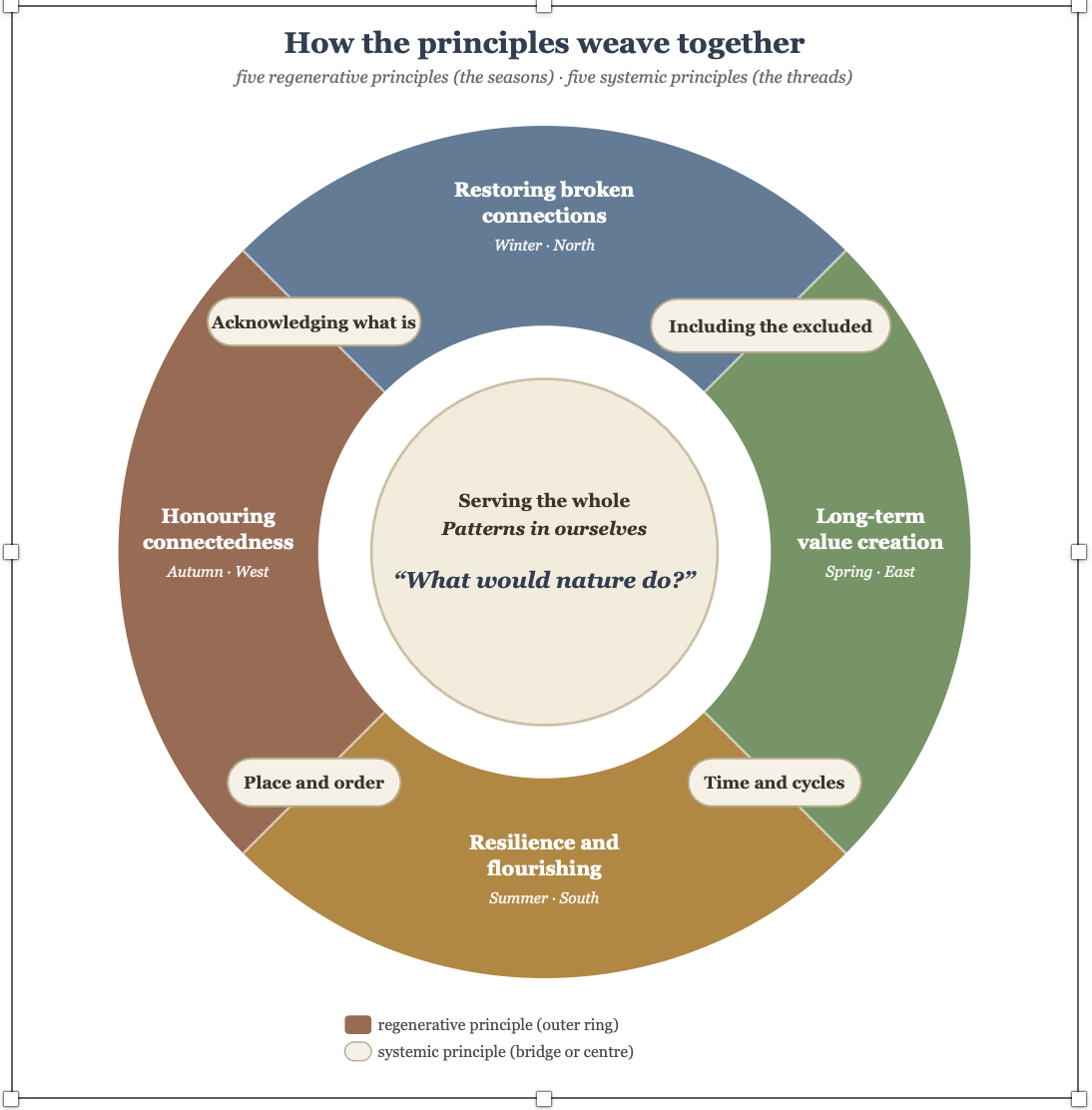
The four seasonal regenerative principles sit on the outer ring; the five systemic principles either bridge two adjacent regenerative principles (sitting at the boundaries) or live at the centre with the fifth regenerative principle.
Acknowledging what is ↔ bridges Honouring connectedness (Autumn) and Restoring broken connections(Winter), you can't reconnect what you won't first see honestly.
Including the excluded ↔ bridges Restoring broken connections (Winter) and Long-term value creation (Spring), future and nature generations are often excluded, as are minority voices; bringing them in restores connection AND creates long-term value.
Time and cycles ↔ bridges Long-term value creation (Spring) and Resilience and flourishing (Summer), both depend on rest, dying-back, and time unfolding on its own.
Place and order ↔ bridges Resilience and flourishing (Summer) and Honouring connectedness (Autumn), flourishing requires each element in its own place; interdependence requires order.
Patterns in ourselves ↔ sits in the centre with Serving the whole system, we cannot serve a whole we are separate from; looking inside shows loyalties that prevents of seeing and serving the whole.
What we take with us
The systemic power of nature only reveals itself when we do not approach her as an instrument, and when we make space within ourselves to truly attune to her. That asks something of us. Not to work harder. First, to notice how we get in our own way. Looking insights reveals patterns and loyalties that keeps us from connecting to the whole. And then, from the nature within ourselves, we start seeing the whole and the future comes into view.
Listening behind the questions the participants worked with and insights from the exercises several things become audible. The participants are professionals, with expertise, position, a track record, yet they are, on a unconscious level perhaps, asking for permission to lead the transformation. Permission from the speed and noise of “much going on”, from a dominant narrative that does not yet welcome what they care most deeply about. They are asking, too, for grief to be allowed in, to slow down, to mourn, to work with climate emotions, because the old professional toolkit no longer reaches far enough. And they are asking it in the singular: what is mine to do, how can I contribute, each carrying their piece on their own shoulders. The ache underneath is loneliness, paired with a wish to widen the circle, to make room for future generations, for children, for unheard voices, for nature, for those who hesitate. The longing, finally, is to belong to something larger than a job: to bring the whole self into the work, to feel that what they love and what they do are no longer two different things, and to live and work in a way that the future, when it arrives, can recognise the care these professionals are willing to put into it.
The regenerative does not have to fight for a place. It receives its place by inviting future and earth into the conversation. From there, movement becomes possible again — and bearable, because we no longer must carry it alone.
Big thank you to the participants and to Martje Fraaije for our great co-operation.
To be continued.