The future is the outcome of all the choices we make
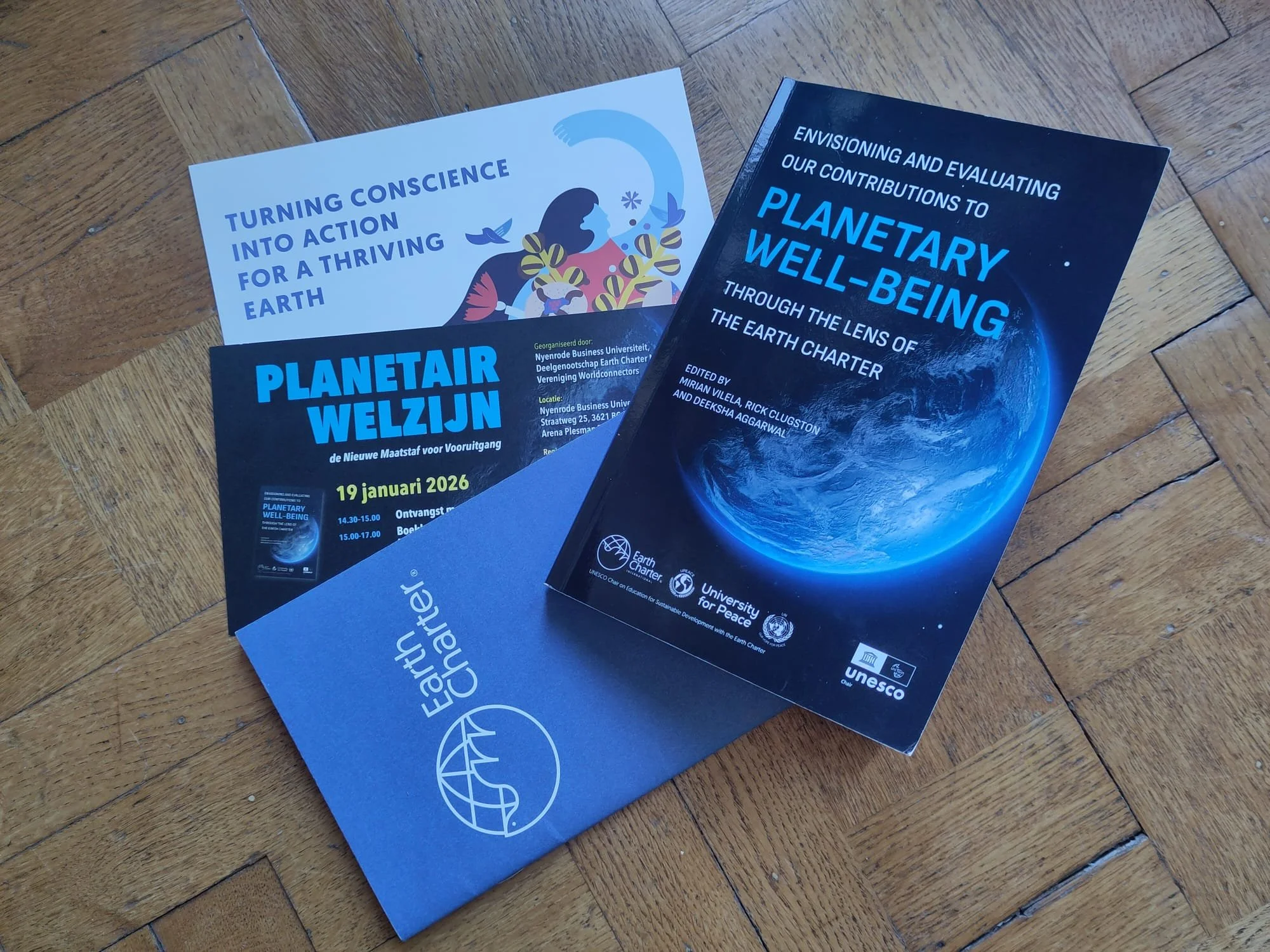
In late 2025, the book Planetary Well-being through the Lens of the Earth Charter was published. Alide Roerink and Veronique Swinkels are the authors of one of the chapters. The book was published by Earth Charter International and the University for Peace.
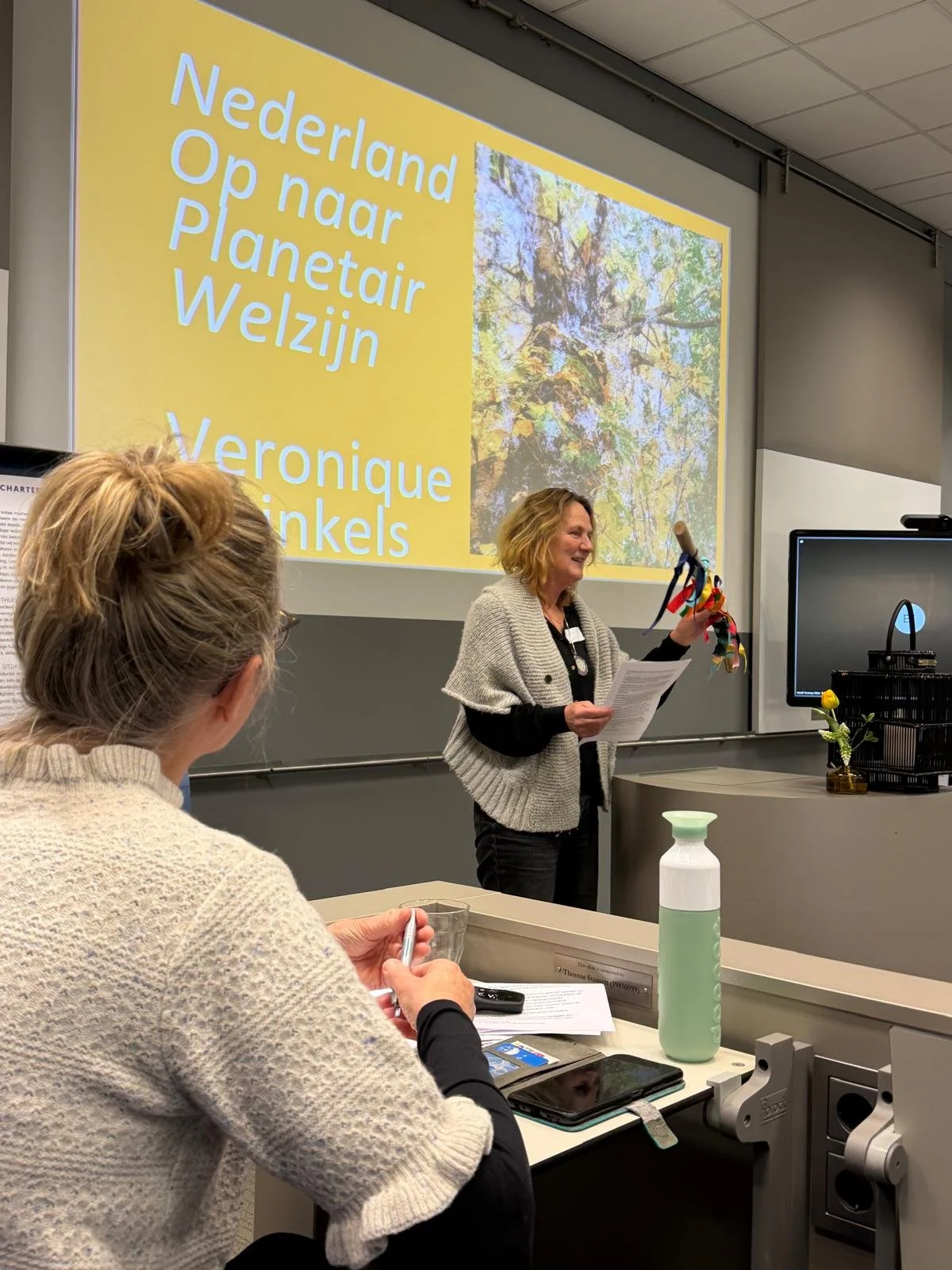
On 19 January 2026, the book was launched in the Netherlands at Nyenrode Business University during the winter gathering of Earth Charter DeelGenootschap Nederland. The column below was delivered by Veronique during the launch.
Thank you all very much for being here. I hope you where able to connect with your favorite tree and the feeling of winter during the visualisation. I will now take you through the chapter that Alide and I wrote together. I only have eight minutes, so this will be a rough sketch.
The foundation for our chapter, “The old economy blinds the Netherlands to planetary well-being: how to integrate our planet and future generations into Dutch democracy”, was laid in the period 2020–2024. During those years, Earth Charter Netherlands and Worldconnectors, an Earth Charter affiliate, organised more than twenty dialogues with over 200 participants. The central question was how the concrete application of the SDGs and the Earth Charter can form the basis for a liveable future – for us, for our planet and for future generations. The focus was always on identifying which developments are already emerging and deserve to be strengthened. In the same period, the SDG Spotlight Report Netherlands was published.
We already know very well what needs to change.
From a Dutch perspective, our chapter clearly reinforces the central thread running through the book: we do not need to invent a completely new future. We already know very well what needs to change. Awareness of these changes is growing and there is an abundance of ideas taking shape. We can begin today by embedding what we already know into laws, budgets, institutions, research, education and daily practice. That would be genuine good ancestorship.
Becoming good ancestors is not a heroic act. It is the cumulative effect of thousands of choices which, because they are grounded in different values and designed differently, lead us towards a different future. Future generations will not judge us by the number of cathedrals or skyscrapers we built, but by the intentions behind the choices we made. They will judge us by the state of the planet we leave behind.
The real question, therefore, is not: what should the future look like? The question is: how do we redesign today’s systems so that care, wellbeing and planetary boundaries become the norm rather than the exception?
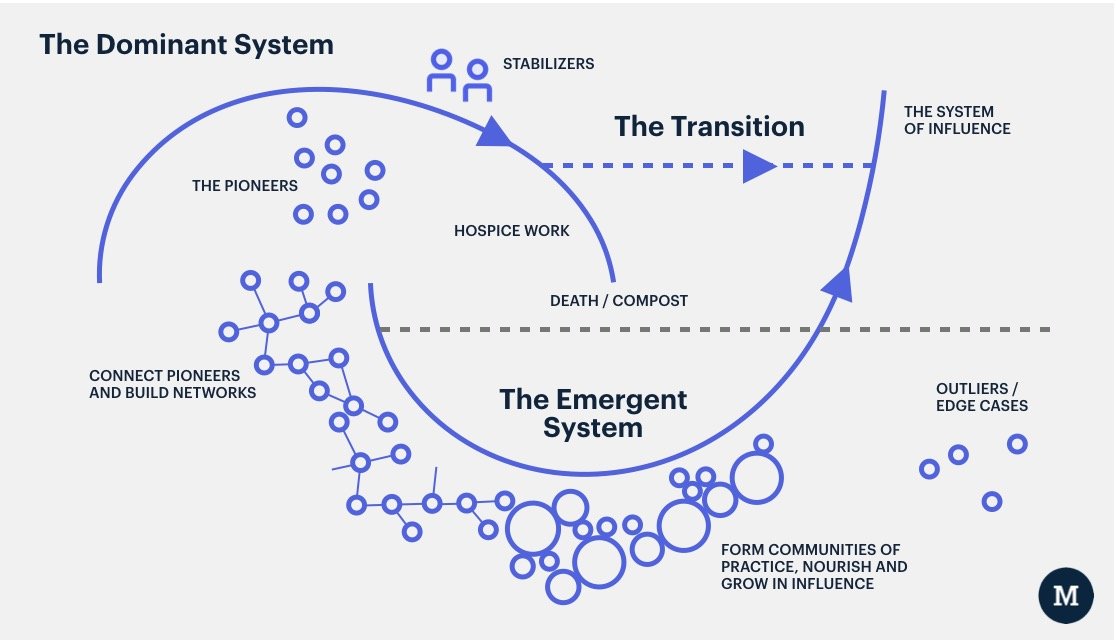
The chapter identifies four practical shifts that show how this can be built step by step, without waiting for a perfect moment or a total collapse. These shifts have a positive influence both on the dominant system – the old economy – and on new structures emerging from the grassroots. It is important to recognise both perspectives: the dominant system must be phased out, while the new system must be built up. Within the dynamics this creates, different roles are needed, working closely together, to bring about real change. The two-loop model of the Berkana Institute provides useful guidance here.
The four shifts identified in the dialogues are:
Develop economic models guided by a wellbeing compass A systemic shift is needed towards an economy that is not driven by growth, but by care, wellbeing and connectedness – an economy that sees both people and nature again. Many examples already exist, such as true pricing that includes all costs, citizen ownership in the energy transition, and basic income. After this shift, we no longer measure growth, but wellbeing – because what we measure determines what we do.
Commit strongly to ecological literacy and the Rights of Nature Greater understanding of the interconnectedness of all life on Earth is essential. This requires integrating ecological knowledge into education, strengthening the commons (shared stewardship of energy, land, air and water), placing biodiversity at the heart of decision-making, and granting legal rights to nature. After this shift, we protect what makes life possible, it will no longer depend on profit it will be protected from it.
Stand up for inclusive dialogue with representation of young people and future generations Citizen participation must become deeper and more transparent, with structural attention to the interests of future generations. We must truly commit to the perspective of young people. Experiments with citizens’ assemblies and new forms of democracy are essential. By making the future a formal stakeholder, long-term sensitivity and intergenerational responsibility can be embedded. After this shift, those who will bear the consequences will be involved in decisions.
Invest in new and unexpected forms of collaboration More radical collaboration between diverse actors at micro, meso and macro levels is necessary to accelerate societal change. Formal and informal structures must connect, supported by new forms of cooperation. Change often emerges from the grassroots, from the margins, and in collaboration with nature. Cooperatives, DeelGenootschappen and collectives can play a key role in this. After this shift, connections and connecting are keys for success.
“Did you know what was happening – and what did you do about it?”
What kind of society emerges from this?
Probably not a perfect one, but a resilient, relational and mature society. This is the moral shift articulated in the Earth Charter: care for the Earth, justice for present and future generations, and respect for the interdependence of all life.
Imagine children born in 2050, 2080, 2120 – or like our grandson Mees, born seven months ago. They grow up in a world shaped by our choices. If they could speak to us, what would they ask?
“Did you know what was happening, and what did you do about it? How did you actually make your decisions? Did you care for each other and for the planet when things became difficult? Did you include us in your decisions? And hopefully: how good it was that there were many people who truly saw us.”
Transforming awareness into action for a flourishing Earth community is urgently needed, also in the Netherlands, as highlighted by the SDG Spotlight Report Netherlands, titled Beyond Non-Commitment. Fortunately, the dialogues also revealed many places where action is already underway, and examples are emerging that deserve to be followed.
As stated in the preamble of the Earth Charter:
“To move forward we must recognise that, amid a magnificent diversity of cultures and life forms, we are one human family and one Earth community with a common destiny.”
The current economy and decision-making structures stand in the way of future-proof solutions. My trust and hope lie with citizen initiatives, local communities and young (international) changemakers who are increasingly finding one another. Continuing to make different choices also requires inner capacities, which is why we invite everyone to formulate a personal agenda, using the Earth Charter as a compass. Earth Charter Assess offers an excellent starting point for this.
We face a challenging agenda, without the promise of quick fixes. The greatest gift we can give ourselves and future generations is to truly work together on system change – to stay connected, continue the dialogue, and remain open to new insights without judging one another, fully aware that no one holds a monopoly on truth.
Becoming good ancestors is not a heroic act.
I gladly say it again: becoming good ancestors is not a heroic act. It is the cumulative effect of thousands of choices which, because they are grounded in different values and designed differently, lead us into a different future. The future is the outcome of all the choices we make.
Veronique Swinkels 19 January 2026, Nyenrode Business University
With thanks to everyone who contributed to the dialogues. Below are links to the open-access PDF of the book, Earth Charter Assess, reports of the dialogues, the SDG Spotlight Report Netherlands, and the video of the Spotlight Report launch.
https://earthcharter.org/new-book-planetary-well-being-through-the-lens-of-the-ec/
For your personal agenda: https://earthcharter.org/library/ec-assess/
https://www.worldconnectors.nl/wp-content/uploads/Artikel-Veronique-def-SDGs-beyond-Corona-2.pdf
https://www.worldconnectors.nl/werkgroep-sdg-spotlight-report/